 BACK TO NEWS

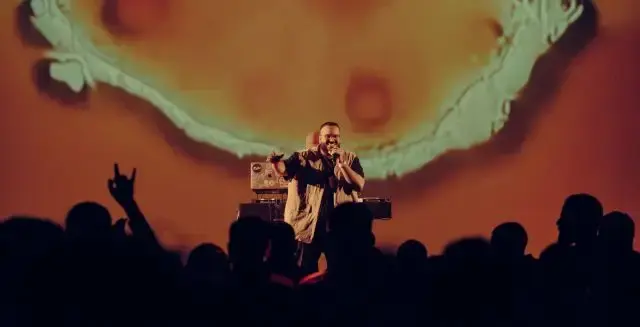
We asked Awtaf about leaving the name Sallam Naser behind, the memories that still shape his writing, and the words from his dialect that carry a whole place inside them.
You released music as Sallam Naser for years. What made you become Awtaf?
Sallam Naser was the boy who was torn away from a place he saw as God’s paradise on earth. He kept holding on to the past as if letting go meant losing it a second time. He was tied to the streets, the houses, the sounds, and everything that destruction, forced displacement and uprooting took from him, but the traces of all those things followed him all the way into exile.
When I arrived in Norway, I understood that exile isn’t just being far from your home; sometimes exile is continuing to live inside a home that no longer exists. “Awtaf” came when I stopped trying to bring Sallam Naser back to the place he came from. It was a shift from nostalgia to understanding, and from writing about what happened to me to writing so I could understand what happened to me had done to me. Sallam Naser remembered; Awtaf came to know why he remembers. And the shift was in thought, in emotion and in music, all at the same time.
If someone could hear just one track from you, which should it be, and why?
“Tayyeb.” Because for me it’s not the track that represents the best rap I’ve made, so much as the track that represents me once I stopped trying to prove I know how to rap. There’s a space in it between what I say and what I couldn’t say, and that exact place is where I’ve come to love writing from. If someone wants to know Awtaf through one track, I’d rather they hear the thing that reveals me, not the thing that shows me off.
“Hakimi” is full of Iraqi references, and Jaha itself seems to build a whole world around Iraq. What pulled you toward Iraq when you were making that project?
I’ve long been drawn to Iraq: to the dialect, the vocabulary, the poetry, and the Iraqi way of expressing grief and love in the same breath.
Especially the latmiya; there’s something in it that pulls me in deeply, because it doesn’t treat grief as something you have to hide or get over, it gives it a voice, a rhythm and a memory.
In “Hakimi” you say “ذكرتوني بنسرين,” and years earlier you released a track called “نس رين.” Is that line a callback to the older song?
Yes, but “Nisreen” was always bigger than the old track. The name is tied to my experience of being detained in the Tadamon neighborhood, south of Damascus, the area that later became known for the massacre. There was a street called Nisreen Street, and it was at the Nisreen checkpoint specifically that I was arrested. After that I was inside a traditional Arab house, and its rooms weren’t rooms in the normal sense; every room held detainees, and torture was part of the night and the day.
So when I say “ذكرتوني بنسرين” (“you reminded me of Nisreen”), I’m not making a cute reference to an old song. I’m saying that memory opened a door I thought I had closed. To people, “Nisreen” might be a girl’s name; to me it was a street, a checkpoint, a house, and a sound that never went away. So the line goes back to the old track, and the old track goes back to a place older than both of them.
What’s something the younger version of you believed about making music that you don’t believe anymore?
I was convinced that good rap had to prove itself: rhyme schemes, rhymes, technique, words stacked on top of each other, and that the listener had to notice you were skilled. Today that’s no longer my question. My question has become: did I manage to convey the feeling? I could write the most complex rhyme in the world and nothing would move in you, and a simple sentence could hit a place in you that you didn’t know existed. I grew up and understood that technique is a tool, not a goal. If I have to break the rhyme to keep the feeling, I’ll break it. And if silence is more honest than a whole bar, I’ll let the silence speak. I no longer want the listener to say, “Look how he wrote that.” I want them to say, “I know this feeling.”
What word or expression from your dialect hits hardest in your music, and why?
“Khayya.” A small word, but it carries a whole world. It’s not just “brother.” There’s a neighborhood in it, friendship, someone calling out to another from the end of the street. There’s the camp in it, Damascus, and the kind of closeness that doesn’t need introductions. Depending on how you say it, it can be love, reproach, anger, a cry for help or a goodbye. For me, dialect isn’t just a way of pronouncing things; it’s an archive. When I say “khayya,” sometimes I’m not calling a person, I’m calling a whole place.
Who’s an underground Arab artist you think more people should be listening to?
Haykal. Because he’s one of those people you feel have their own world, who aren’t trying to chase a ready-made shape of Arabic rap. And I respect the artist who, when you hear them, you know it’s them even before you know the name of the track. In my opinion, Haykal deserves much more space and to be listened to much more.
You’ve already worked with El Rass, Synaptik and Al Nather. Who’s still on your collaboration wishlist?
Mihrak – Harfain. But in general I don’t treat collaboration like a list of names I have to cross off one after another. The best collaboration for me is when two people walk into the room, and each of them walks out with something they wouldn’t have made on their own. I don’t want someone to put a verse on my track, or for me to put a verse on theirs. I want the distance between the two worlds to make another world.
If your music were a place, where would it be?
Al-Orouba Street, Yarmouk Camp. Not because it’s the most beautiful place in the world, but because it’s the place that taught me what it means to have a whole world within a few streets. There, people knew each other, the sounds ran into one another, the smell of food came out of the windows, kids were in the street, and problems, love and life all walked side by side. If my music were a place, I don’t imagine it as a studio or a stage. I imagine it as a street, Al-Orouba Street specifically. Because no matter how far I go with music, I feel there’s a thin thread still holding it from there.
You’ve lived and written across Palestine, Syria, Norway and the wider Arab world. When you write now, where do you feel like you’re writing from?
On the roof of my house. Maybe my body is in Norway today, and maybe my life has passed between many countries, names and borders, but when I write I don’t feel like I’m writing from a country. I go back to the rooftop, to the same view from above, to the same neighborhood, to the same sounds rising from below, and to the boy who thought the whole world was more or less contained within the distance his eyes could reach. The strange thing is that a person can travel thousands of kilometers, and in the end discover that he spent his whole life trying to get back to a distance of twenty meters. I write from Palestine, from Syria, from Norway, and from every place that passed through me. But if you ask me where the sentence comes from? From the roof of my house. Maybe I left the place, but the place still hasn’t left me.