 BACK TO NEWS
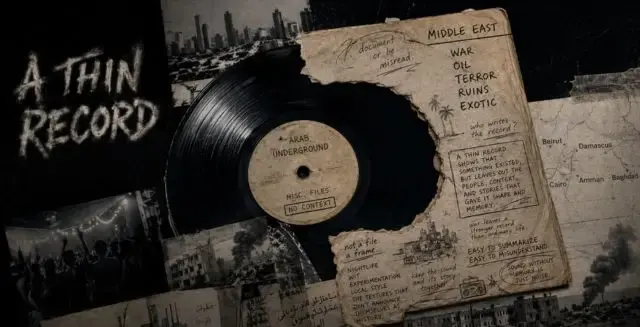
People can be overexposed and under-documented at the same time. Some places are photographed to death and still left on thin record.
A thin record shows that something existed, but leaves out the people, context, and stories that gave it shape and memory. The Arab world has lived under this arrangement for years, reduced again and again to the same exportable images of smoke, oil, militias, towers, princes, ruins, danger, excess.
Harfan Harfan is built around what thin records leave behind: the scenes around songs, the histories behind them, and the frame that keeps them from blurring.
A thin record leaves too much room for misreading. Places get pinned to one rough association and rarely escape it. Iraq enters through OutKast’s “Bombs Over Baghdad”. Beirut turns up in Redman’s “I execute like wars in Beirut”. None of this is even considered a distortion. That is what makes it so unjust. Shabjdeed pushes back on that assumption. In “Arab Style”, the line “War zone is where I die” throws that assumption back sarcastically instead of letting it pass as truth.
Arab names, cities, accents, and even fragments of language circulate easily when tied to drama. What crosses borders too often is sound stripped of memory. A track may travel, but the context that made certain lines land (and others sting) usually does not. In underground Arabic music, songs get misfiled, folded into vague “Middle Eastern” categories, and heard as if they came from nowhere. Sounds move across the region freely, but are too often documented as though they belong to separate worlds.
War usually leaves a stronger record than ordinary life. Of course it does: destruction is easier to archive than the life around it. What falls away more quickly is Arab wit, nightlife, experimentation, local style, and all the smaller textures that do not announce themselves as history. In a region so often read through rupture and separation, that imbalance helps keep the record thin.
The record will never be complete. That is not the problem. The problem is what happens when it stays thin. It leaves Arab culture easy to summarize from the outside, and easy to misunderstand from a distance. In the absence of context, the most dramatic version of a place is often the one that survives.
A thin record leaves behind its own afterlife. Harfan Harfan exists to keep the sound and its story together.